
expertsciencecontent.com

One Man, 40 Million Trees: The Living Legacy of Jadav Payeng, the ‘Forest Man of India’

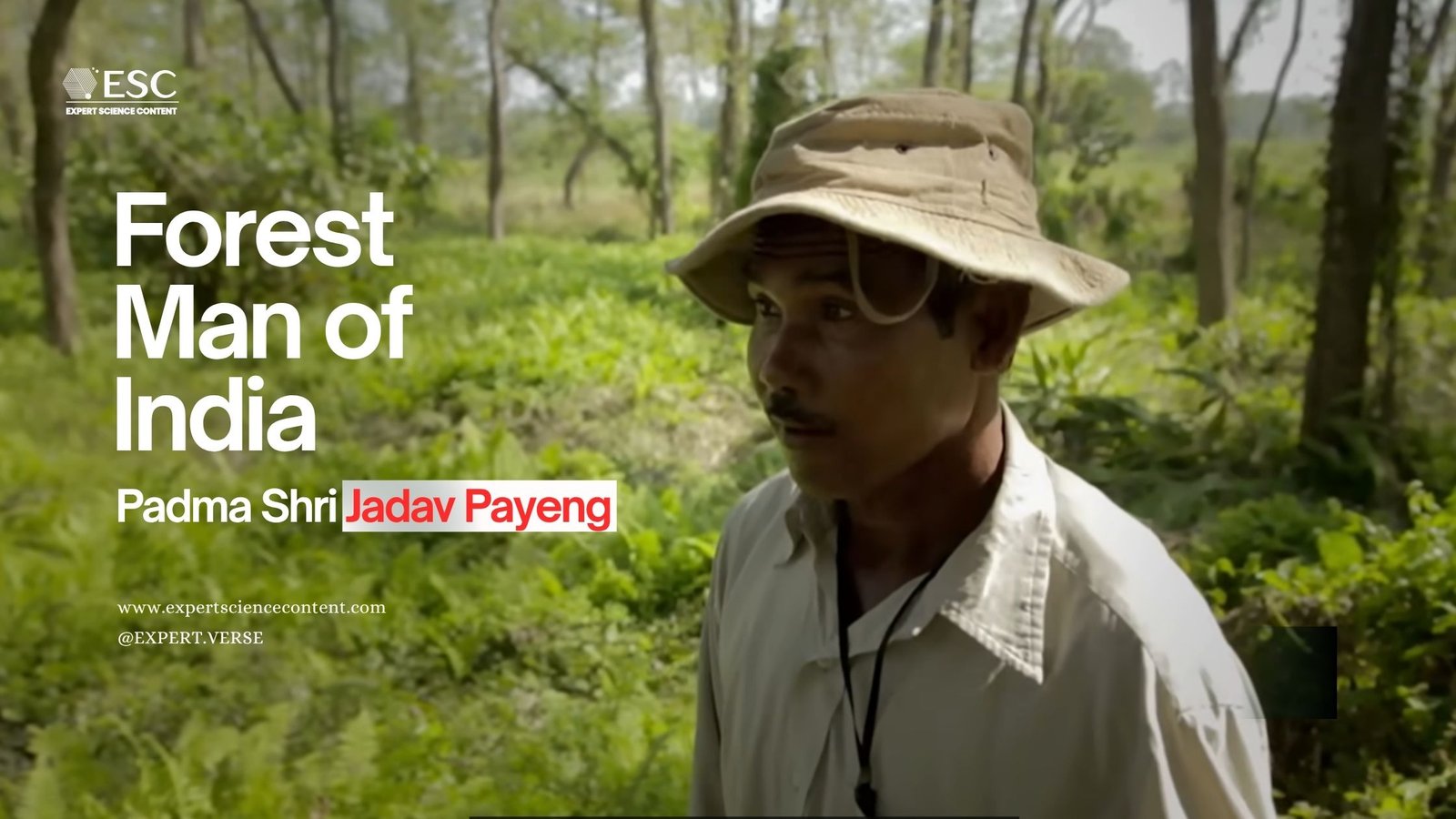
forest man, Jadav Payeng

Feature image by @forestmanofindia, and header image by @expertsciencecontent on Instagram
The Genesis of a Planetary Healer

In the late 1970s, the floodplains of Assam witnessed an ecological tragedy that would change the trajectory of global conservation. Following a devastating flood in 1979, a 16-year-old indigenous youth named Jadav Payeng stood upon a barren sandbar of the Brahmaputra River. Before him lay hundreds of dead snakes, washed ashore and killed by the scorching heat on the unshaded, nutrient-depleted silt.

To a casual observer, it was the harsh reality of riverine geography. To a natural born healer, it was a systemic failure of the landscape.

On that day, Payeng made a quiet, definitive choice to heal the fractured ecosystem.  He started growing plants on the barren sandbar, during 1980’s leaving his education and home. 

What followed over the next four decades is an unprecedented masterclass in ecological restoration, proving that a single human being can counter the Anthropocene’s destructive footprint through sheer, unyielding alignment with nature.

Engineering an Ecosystem: The Soil Regeneration Phase

Forest man of IndiaFrom a scientific standpoint, creating a forest on a shifting sandbar in the middle of a turbulent river is an algorithmic nightmare. Sandbars are inherently unstable, characterized by low organic carbon, minimal water retention, and a complete lack of nitrogen-fixing microbial networks.

Payeng did not merely plant seeds; he engineered an ecosystem from the ground up.

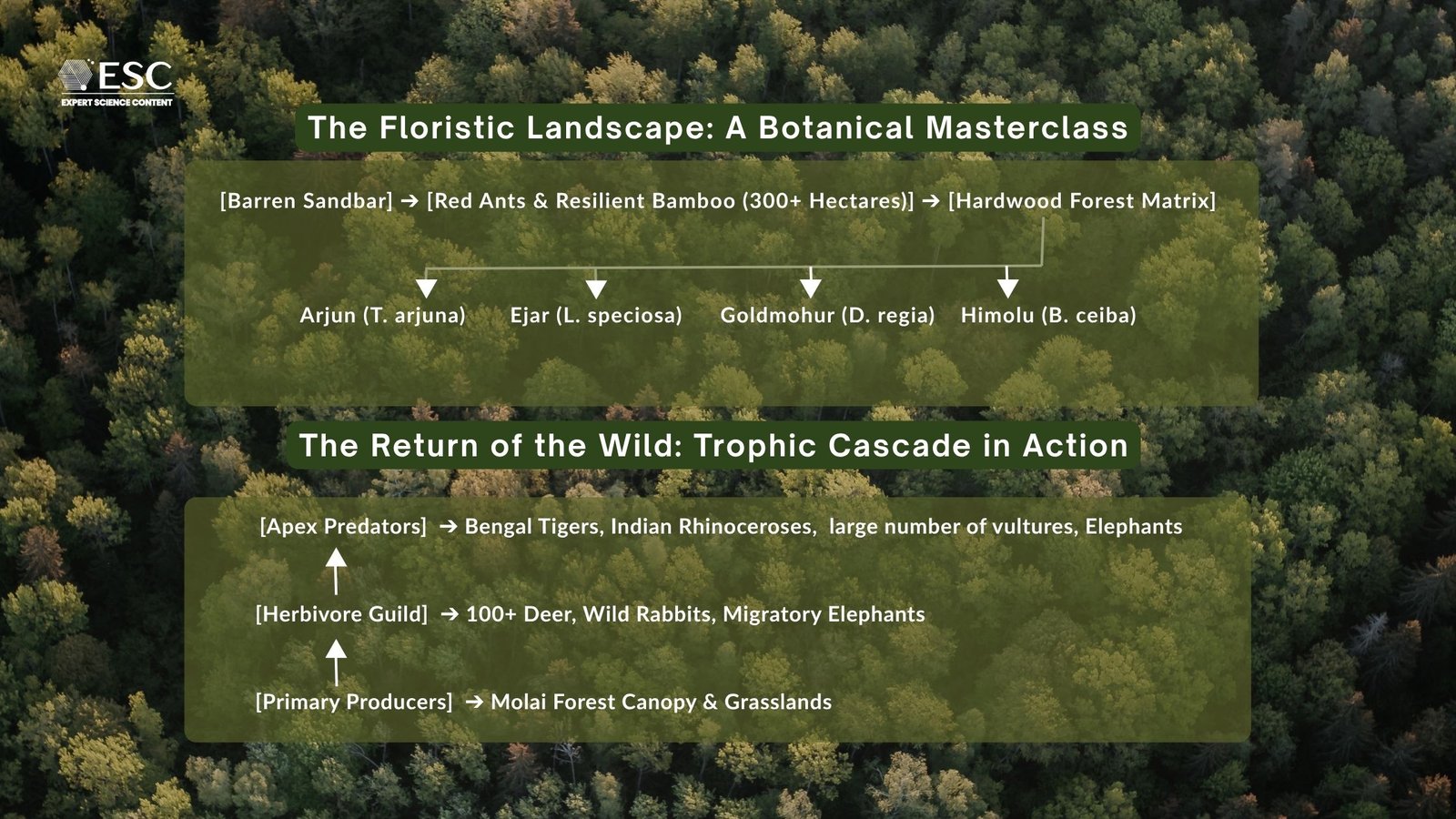
To overcome the sterile nature of the Brahmaputra silt, he introduced organic catalysts. He transported thousands of red ants from his village to the sandbar. Biochemically, these ants altered the soil matrix, burrowing deep to aerate the compacted sediment, accelerating the decomposition of organic leaf litter, and enriching the soil with essential nitrates.

He initiated the flora hierarchy with resilient, non-demanding species like bamboo, which stabilized the shifting sands, altered the microclimate, and paved the way for more complex botanical life.
The Floristic Landscape: A Botanical Masterclass

forest man of IndiaToday, the Molai Forest encompasses over 1,360 acres (550 hectares) of dense, multi-tiered canopy near Kokilamukh in Jorhat, Assam. It stands as a profound baseline for successful afforestation.

Payeng’s meticulous, intuitive selection of species showcases deep ecological wisdom. He introduced highly functional indigenous trees, including:

  • Arjun (Terminalia arjuna) and Ejar (Lagerstroemia speciosa) for heavy soil binding and moisture retention.
  • Goldmohur (Delonix regia) and Koroi (Albizia procera) for canopy coverage and microclimate cooling.
  • Moj (Archidendron bigeminum) and Himolu (Bombax ceiba) to attract diverse avian vectors.

With bamboo covering more than 300 hectares, the complex structural root systems have effectively mitigated riverbank erosion, turning a fleeting sandbar into a permanent, immovable geographic anchor.

The Return of the Wild: Trophic Cascade in Action

The ultimate validation of Payeng’s planetary healing is the spontaneous return of apex predators and megafauna—a phenomenon biologists call a trophic cascade.

What began as restoring the riverside sandbar evolved into a fully operational wildlife sanctuary. The 1,360-acre reserve is now a critical refuge hosting:

  • Bengal Tigers and endangered Indian Rhinoceroses.
  • A thriving herbivore guild of over 100 deer and wild rabbits.
  • A complex avian ecosystem, notably acting as a sanctuary for highly threatened vulture species.

Payeng’s role quickly transitioned from an ecologist to a frontline guardian. In 2013, when sophisticated poaching networks attempted to infiltrate the forest to harvest rhino horns, Payeng’s deep tracking skills and immediate mobilization of state forest department officials thwarted the operation. He protected the ecosystem he single-handedly built, proving that human stewardship is inseparable from wildlife preservation.

The world could not keep this quiet revolution hidden in the mists of the Brahmaputra for long. Jadav Payeng was honoured with the title ‘Forest Man of India’ by the Jawaharlal Nehru University, on 22 April 2012, a moniker that has resonated across global environmental forums.

In 2015, the Government of India bestowed upon him the Padma Shri, one of the nation’s highest civilian honors. Recognizing the profound academic and scientific value of his practical conservation techniques, both Assam Agricultural University and Kaziranga University awarded him Honorary Doctorate degrees.

His journey has inspired global cinema and media. He has been the subject of multiple internationally acclaimed documentaries, and his life served as the foundation for the pan-Indian cinematic epic Haathi Mere Saathi (released alternatively as Kaadan and Aranya), introducing his legendary environmental perseverance to millions worldwide.

              From a local sandbar to global academic honors, his blueprint redefines modern forestry.

The Future Horizon: Expanding the Green Matrix

At 66 years old, Jadav Payeng shows no signs of entering a standard retirement. For a true planetary healer, the work is never finished while barren spaces remain.

His immediate future plans include replication and scaling. Payeng is actively preparing to apply his proven afforestation methodology to adjacent, highly vulnerable sandbars within the Brahmaputra river system. His vision is to create a contiguous green corridor that stabilizes the river basin, creates permanent wildlife migratory paths, and establishes a natural bulwark against the intensifying threat of climate-induced flooding in Northeast India.

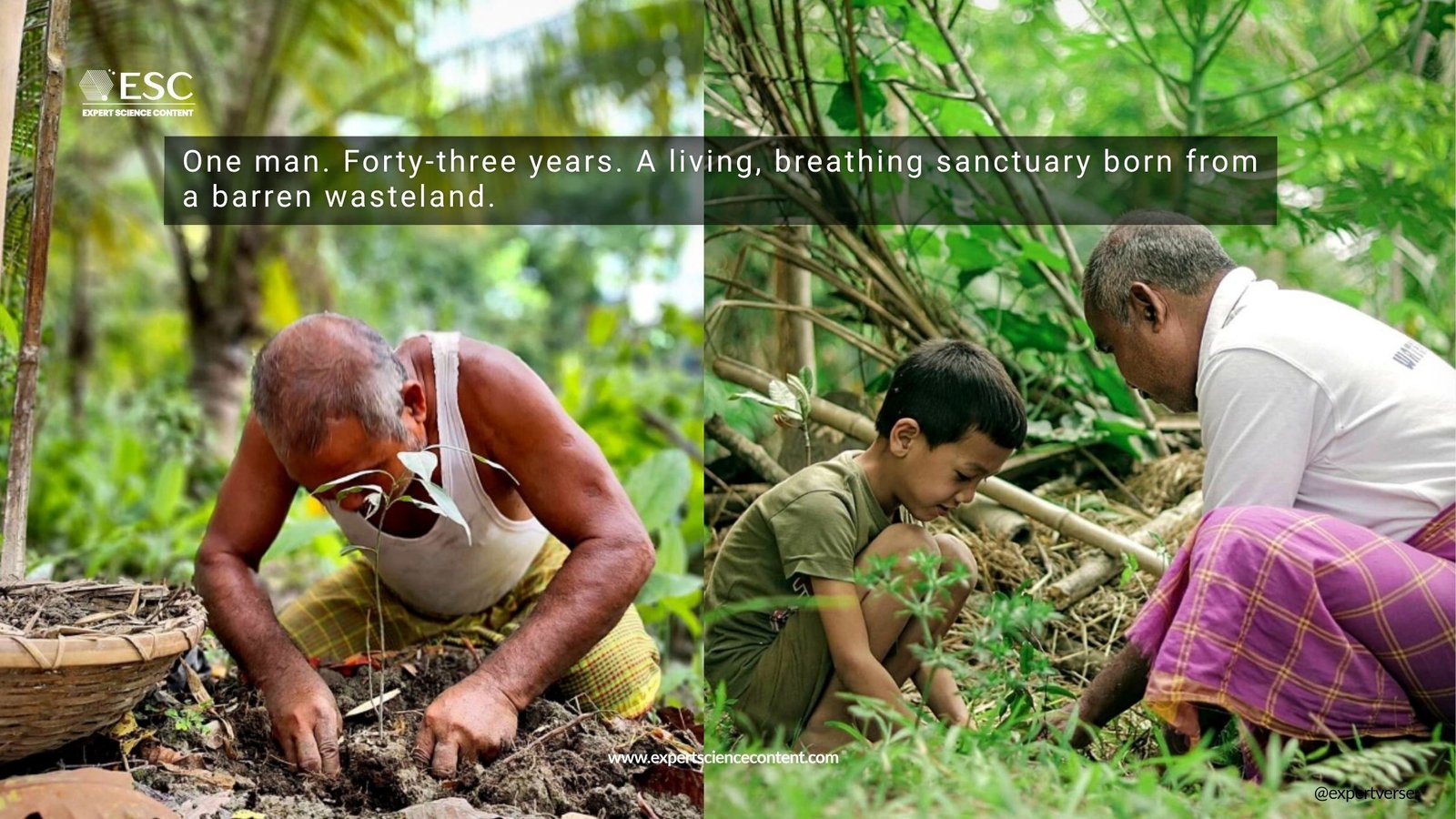
                One man. Forty-three years. A living, breathing sanctuary born from a barren wasteland.

Forest man of India
Feature image by @forestmanofindia

Why Every Tree Matters

The story of Jadav Payeng is not merely a heartwarming tale of human endurance; it is an urgent scientific directive for our collective future.

Forests are the primary terrestrial lungs of our planet. They regulate global carbon cycles, sustain pollinator populations vital for human food security, and balance regional hydrological systems. When we destroy a forest, we do not just lose trees; we disrupt the intricate biological networks that keep human civilization viable.

Payeng’s lifework challenges the prevailing narrative of climate despair. If one individual, operating with basic tools and profound empathy, can regenerate 1,360 acres of pristine wildlife habitat, imagine what a unified global community can achieve. Every seed planted, every tree protected, and every blood donation that sustains a human life stems from the exact same core truth: EVERY SINGLE CONTRIBUTION MATTERS TO THE WHOLE.

Let us look at the Molai Forest not as an anomaly, but as a blueprint. It is a living proof that nature possesses an extraordinary capacity to heal, if only we have the courage, the patience, and the humility to lead the way.

In our Legacy Series, Expert.Verse analyzes the blueprints of global planetary healers whose lifetime work redefines ecological stewardship. This feature is an independent editorial tribute to the masterclass of Jadav Payeng, the ‘Forest Man of India’

Read More:

  1. “Jadav Molai Payeng – the ‘Forest Man of India’, Current Science, 25 February 2014” (PDF). Retrieved 21 March 2014.
  2. https://www.youtube.com/watch?v=HkZDSqyE1do  
  3. https://www.youtube.com/watch?v=U1jtd3MrFQM 

Dr. Anindita Talukdar

The creative behind ESC sharing smart actionable tips and insights to level up writing and research skill.

Join ESC
Get our newsletter

Dr. Anindita Talukdar

The creative behind ESC sharing smart actionable tips and insights to level up writing and research skill.

Join ESC
Get our newsletter

Leave a Reply

Your email address will not be published. Required fields are marked *